
In this post, I’m sharing how I upgraded the crowded and cluttered shelves in my sister’s garage with DIY cabinets and a mobile workbench.
The original open shelves in this garage were okay–but not ideal.
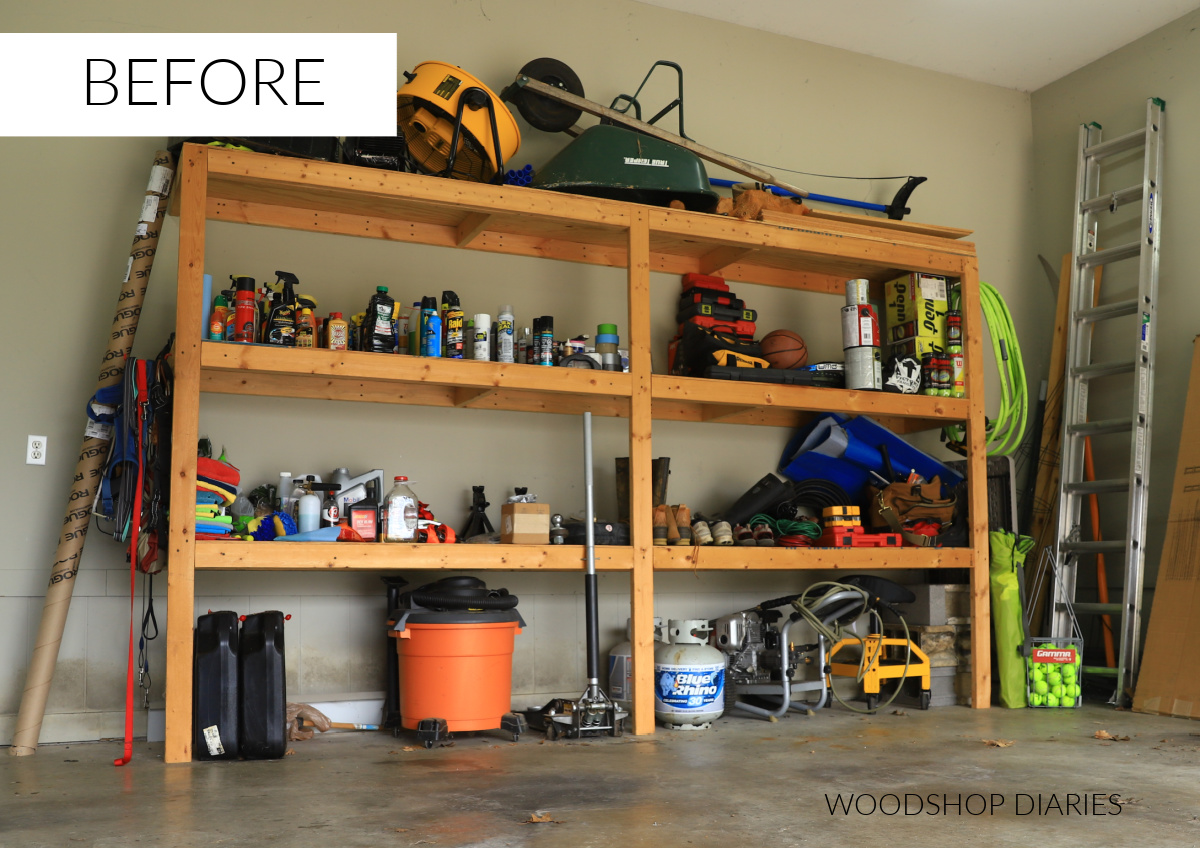
While these basic shelves did provide several layers of storage to get things off the floor, there was quite a bit of wasted space between each one.
And it was really difficult to see or reach what was in the back.
So, to better utilize this wall space, I built them custom garage cabinets with pull out drawers, adjustable shelves, and a mobile workbench with tote storage.
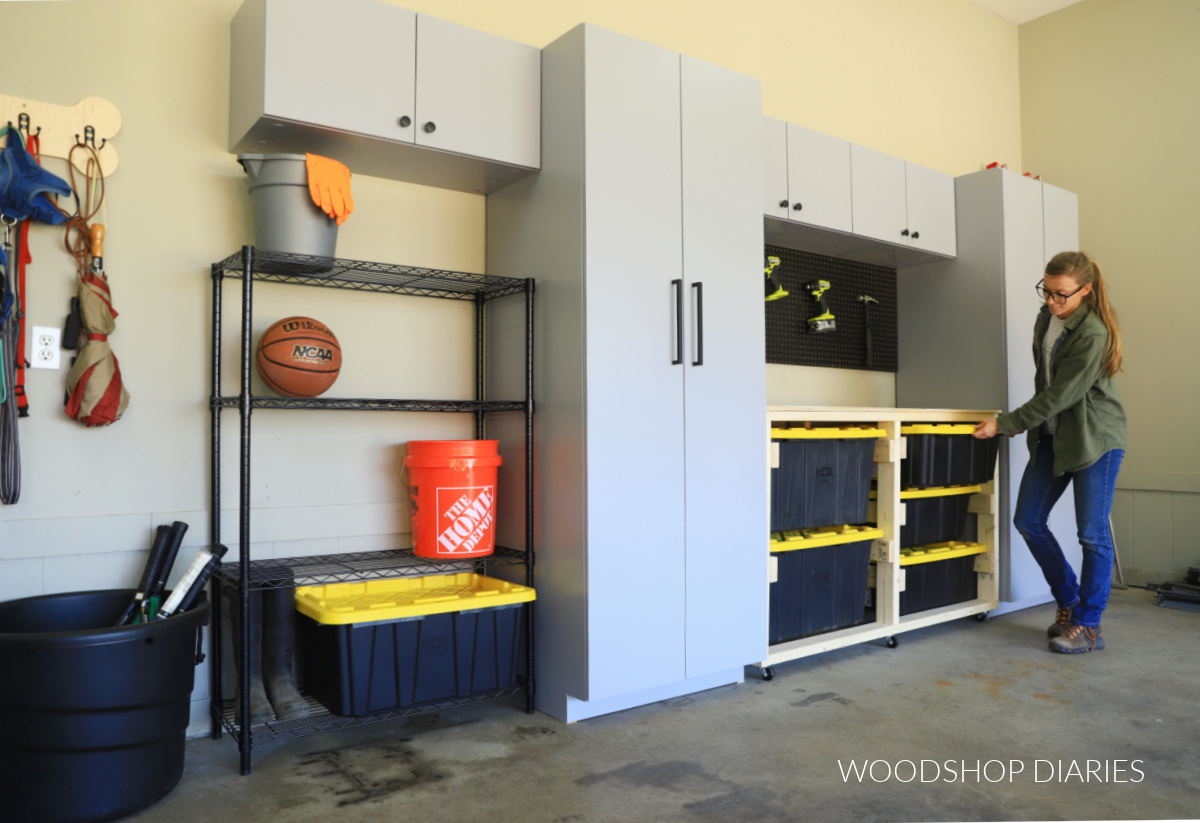
I’m so excited with how this turned out, so I’m sharing plans to build your own garage cabinets with workbench storage just like these in the post below!
*This post contains affiliate links. See website policies.
What to know before building
These simple cabinets and tote workbench pack a TON of storage and can easily be built in just a couple days.
While they were designed and built for a garage, this same design could be used inside the home, too (think: craft room or home office!).
Before we dive into the how-to, let’s address some common questions you may have about building your own garage cabinets.
What kind of wood should you use for garage cabinets?
Garage cabinets and workbenches can be made from many different materials–metal, plastic, wood, etc. Wood is a great, inexpensive option to build with.
In this case, I built the cabinets using 100% plywood and the workbench was made from construction grade 2x4s.
Cabinet grade hardwood plywood (like the birch plywood I used for these) is a great option for cabinets because it’s dimensionally stable and very strong.
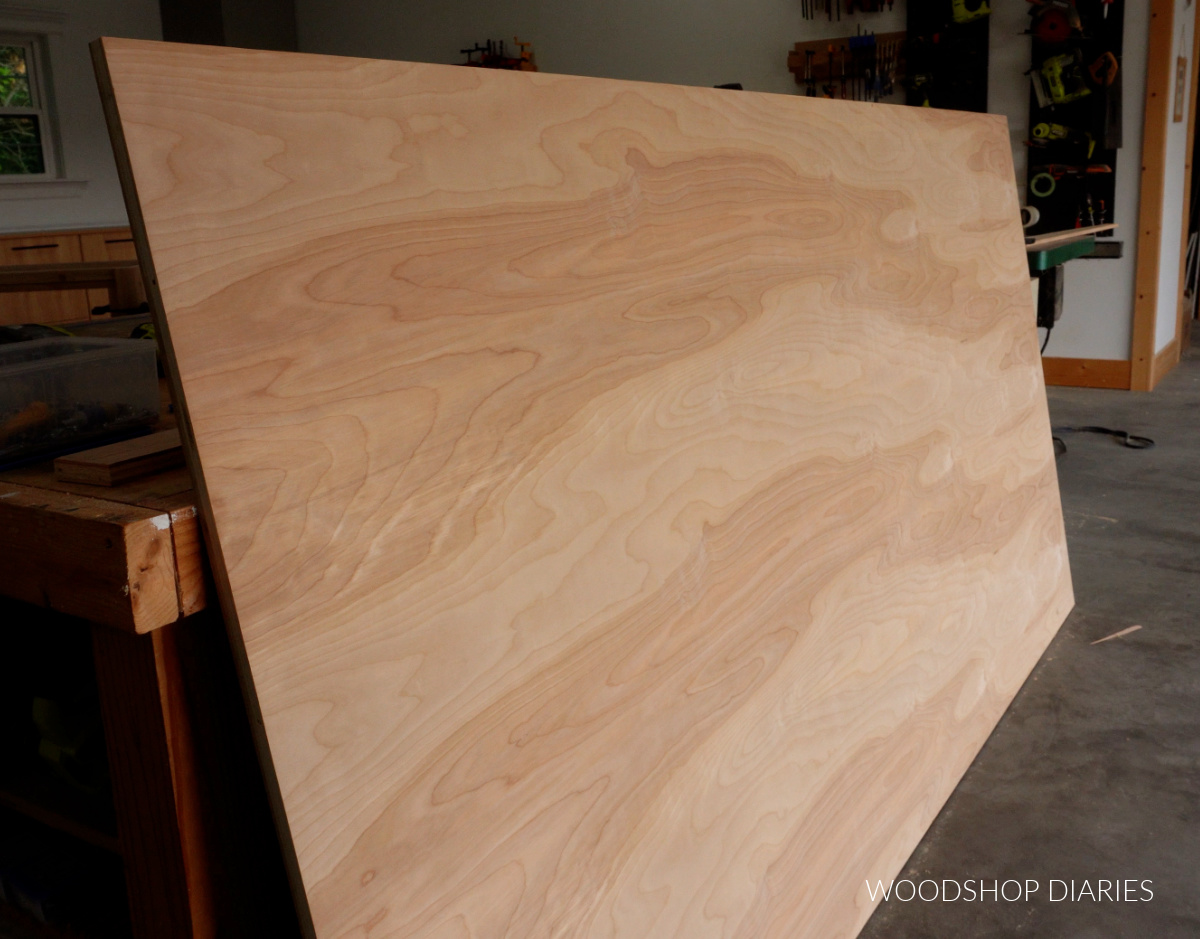
This means it can stand up to temperature and humidity fluctuations and can hold all those heavy items you’re typically storing in the garage or workshop.
I highly recommend using a hardwood plywood (like birch, maple, or oak) for cabinets. However, sanded pine plywood is another option that might save a bit of money.
RELATED: How to choose the right plywood for your project
Note that sanded pine is more likely to warp, can’t hold as much weight, and tends to be much rougher than hardwood plywood. But for garage applications, that might be fine.
If you’d like to see what sanded pine plywood looks like, I used it to build this miter saw station.
TIP: If your garage floor sweats, it can damage the bottom of plywood cabinets over time. If you have a lot of moisture in your shop or garage, be sure to shim up your cabinets so they’re not sitting directly on the ground or consider installing a moisture barrier between them and the floor.
You may also consider building a simple base made of treated wood to rest your cabinets on.
Is it cheaper to buy or build your own cabinets?
Which is cheaper–building or buying? This is always the number one question I get about projects like this.
This is the 14th set of cabinets I’ve built for either a garage, closet, workshop, laundry room, home office, or a kitchen. Prices have changed a lot over the years, but in every case, building my own was DEFINITELY cheaper than buying them.
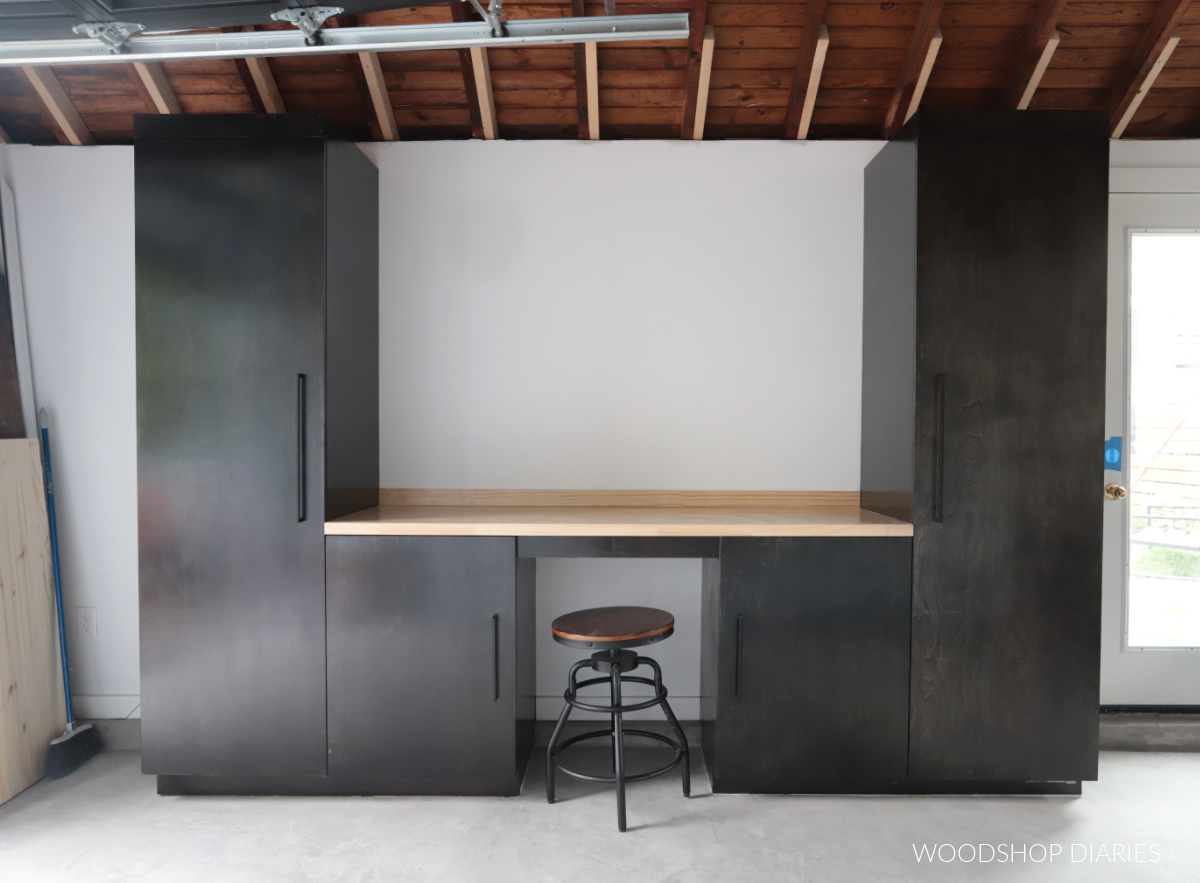
Of course, everything depends on your location, the type of cabinets you’re buying/building, how many, and the layout of your space. So the exact savings will vary.
But for reference, the cabinets and workbench built in this post cost approximately $900 in lumber and materials (in April 2025). A similar set of prefabbed cabinets (the cheapest option I could find) cost well over $1600 (and that doesn’t even include a workbench).
On top of that, the cabinets I built here were made from hardwood plywood and the prefabbed cabinets were made from particle board. So the ones I built were both cheaper AND better quality.
Want to build your own garage cabinets (plus workbench) without the guesswork? Grab the printable building plans here!
Overall Dimensions
The great thing about building your own garage cabinets is that you can customize the size, mix and match pieces, or add extra cabinets to make this work for your own space.
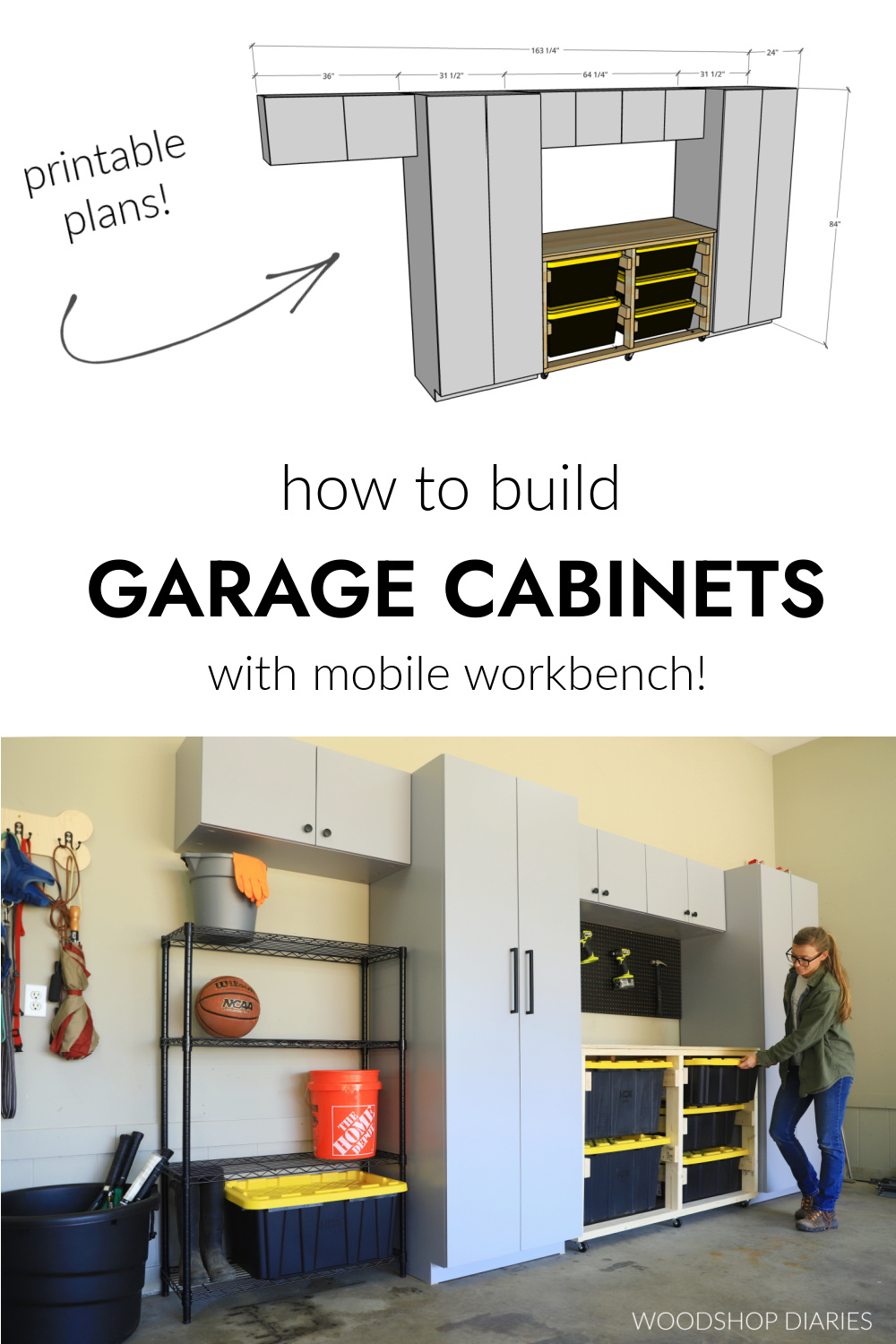
I built this project in 5 pieces: the workbench, two tall pantry style cabinets, a large upper cabinet that goes above the workbench and a smaller upper cabinet that goes on one side of one of the taller cabinets.
This particular design, once assembled and installed, measures approximately 24″ deep x 84″ tall x 163 ¼″ wide.
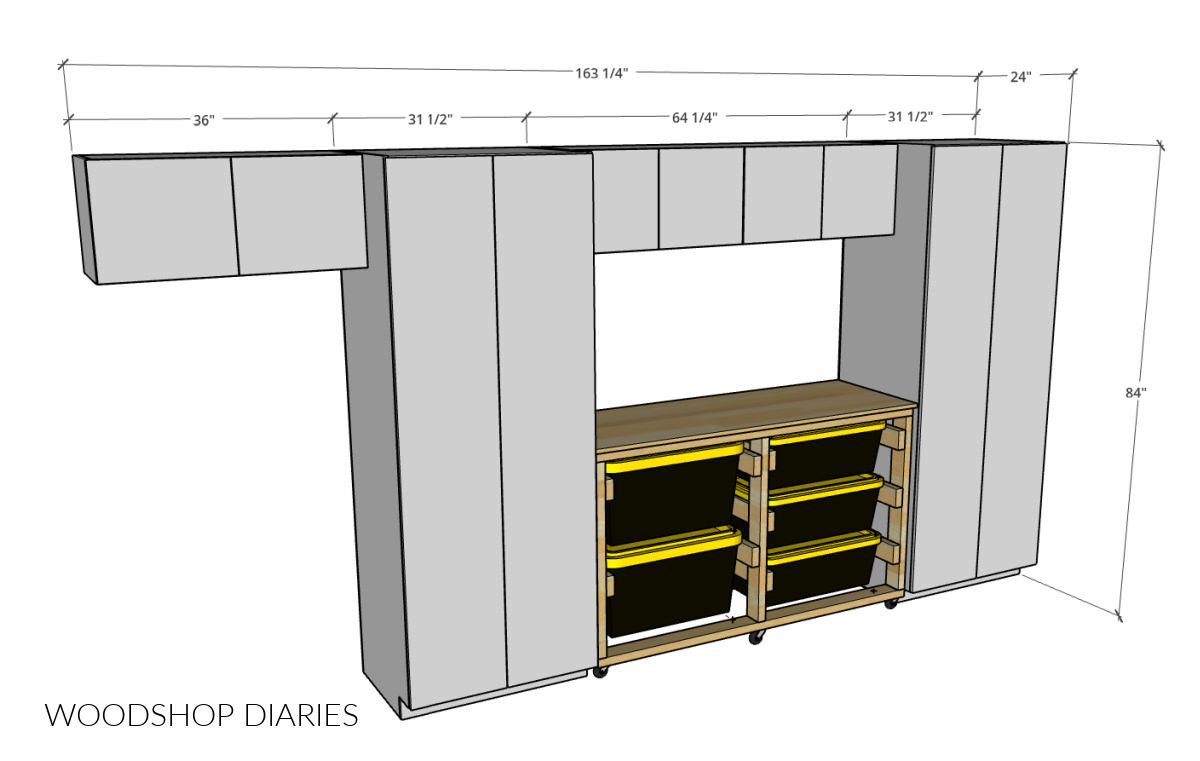
The tall cabinets are 31 ½″ wide, the small left cabinet is 36″ wide and the middle upper cabinet is 64 ¼″ wide.
You might find these resources helpful throughout the build:
Are DIY projects your thing? Sign up for our newsletter for priority access to the latest projects and build plans!
How to build Garage Storage Cabinets with Workbench
If you prefer to watch, I’ve shared the full build video with tons of tips, behind the scenes, and additional details on my YouTube Channel here.
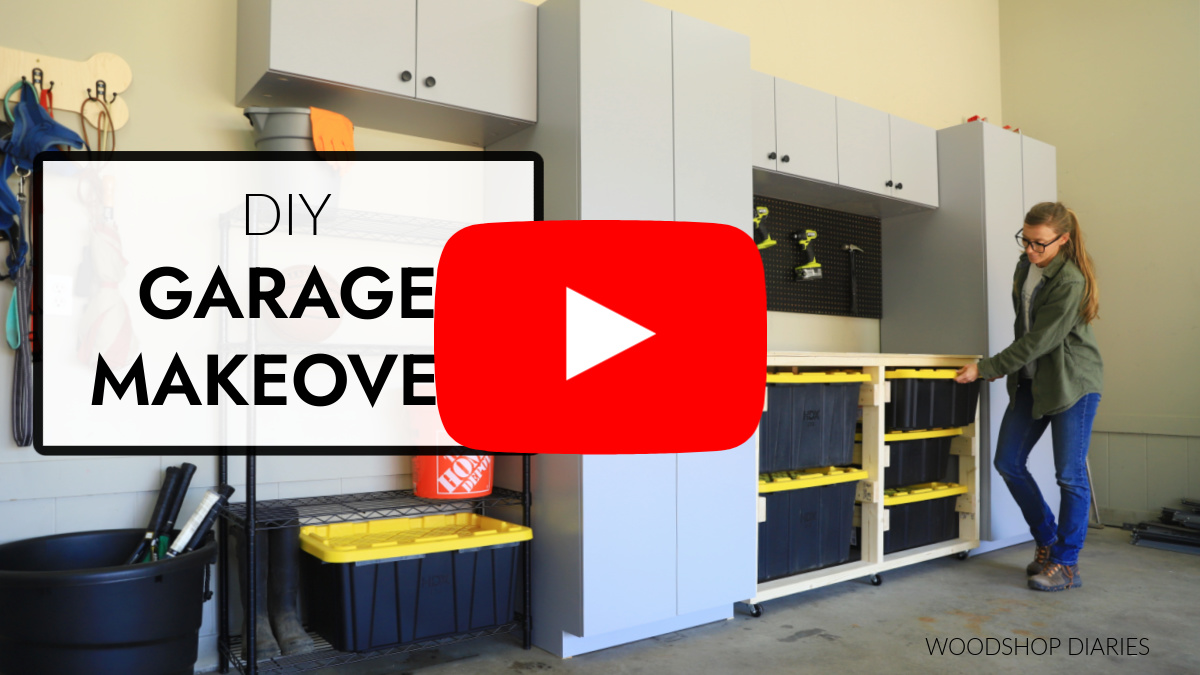
Love watching how-to videos? Subscribe to my YouTube channel for plenty more where that came from!
Prefer to print? Grab the printable garage cabinets with workbench building plans here:
Tools & Materials
Tools:
- Circular Saw
- Miter Saw
- Cutting Guides (Kreg Rip Cut and AccuCut)–optional
- Pocket Hole Jig
- Drill/Driver
- Jig Saw
- Concealed Hinge Jig
- Shelf Pin Jig
- Crown Stapler OR Brad Nailer
Materials:
- (8) 2x4x8 boards
- (8) 4’x8′ sheets ¾″ plywood
- (3) 4’x8′ sheet ¼″ plywood
- (1) 250 count box 1 ¼″ pocket hole screws
- (1) 1 lb box 1 ¼″ wood screws
- (1) 1 lb box 2 ½″ wood screws
- (6) 2″ wood screws
- 1 ¼″ brad nails
- (6) 2″ caster wheels
- (6) pair of 22″ drawer slides
- (12) pair frameless overlay concealed hinges
- Shelf Pins
- Wood Glue
- Edge banding (optional)
- (2) HDX 27 Gallon Totes
- (3) HDX 14 Gallon Totes
Step 1: Assemble Mobile Tote Storage Workbench
I assembled the workbench first because it’s one of the easiest parts to build. This mobile workbench frame was made from inexpensive construction grade 2x4s.
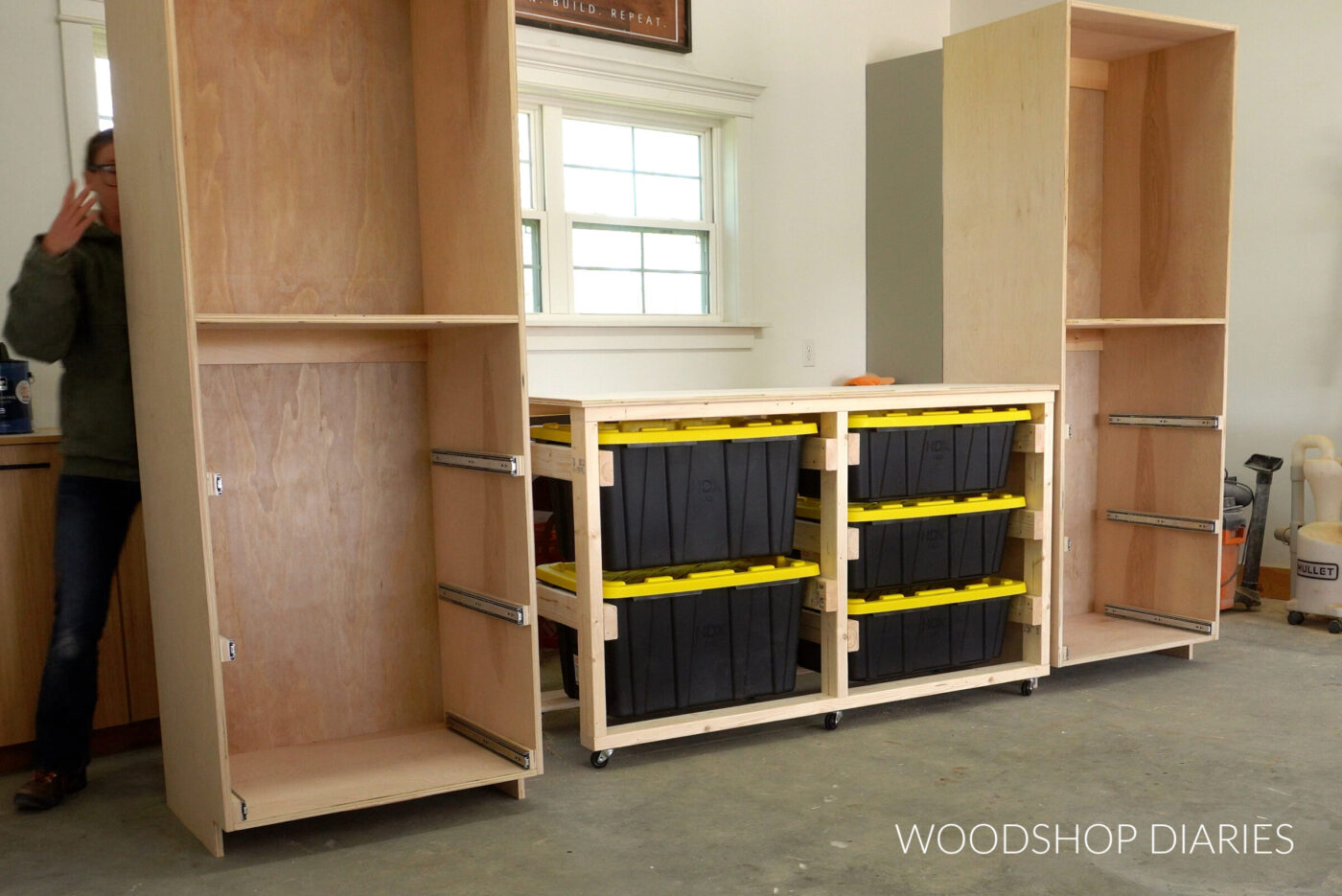
It’s designed to house 5 plastic storage totes–two larger ones in one side and three smaller ones in the other.
I’ve got all the details on exactly how I built this mobile tote storage workbench in a separate post here.
Essentially, I made two frames–one for the front and one for the back. Then I installed 2×4 supports between them that were spaced apart a little over the height of the storage totes.
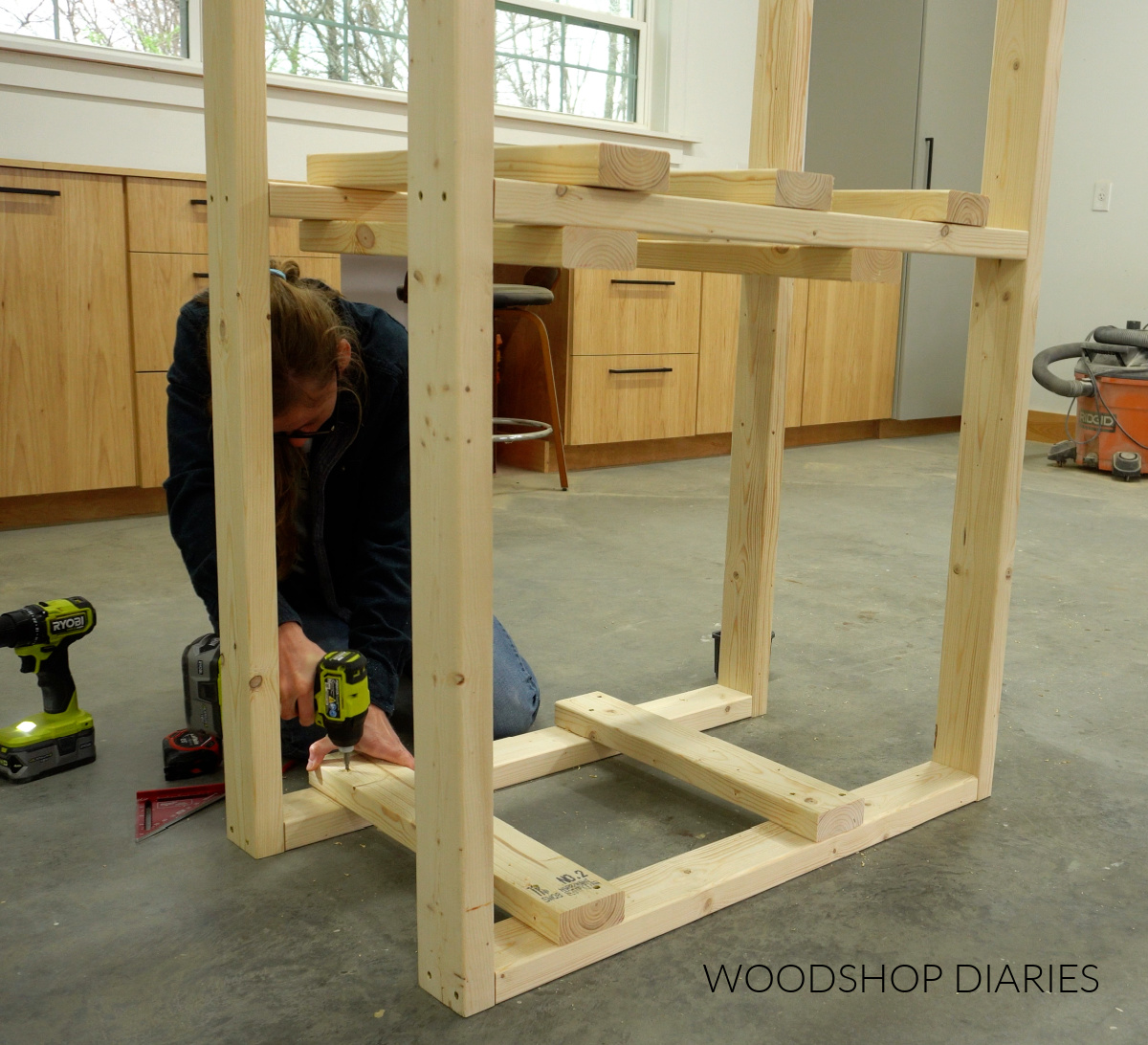
Then, I cut and added a ¾″ plywood top and some caster wheels to make it mobile.
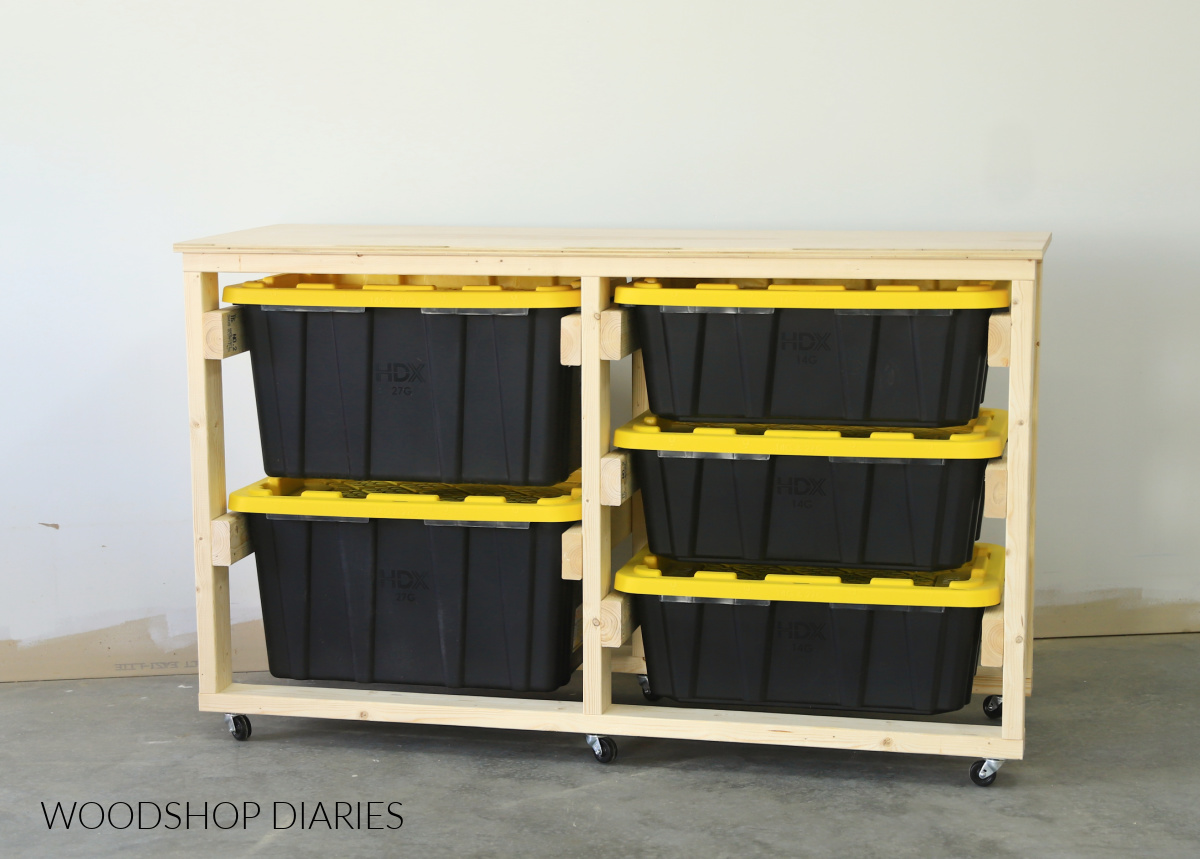
Once the workbench was together, I rolled it aside so I could build the cabinets.
Step 2: Assemble Tall Storage Cabinets
Next, I built two tall pantry-style cabinets to go on each side of the workbench. These large cabinets would provide the bulk of the storage in the garage.
I cut ¾″ plywood to build these cabinet boxes from. Each cabinet would need 2 large side panels, 2 back support strips and three panels to connect at the top, middle, and bottom. All dimensions can be found in the printable plans.
To keep things simple, I assembled these cabinet boxes using pocket holes and screws.
RELATED: How to use pocket holes
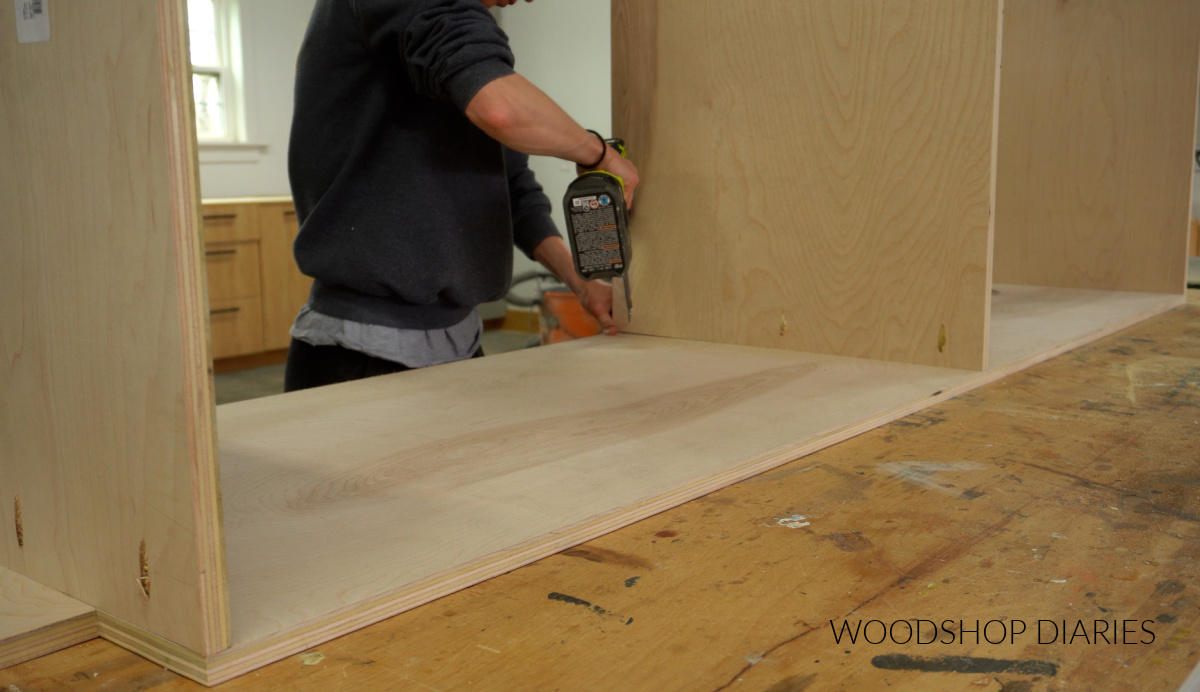
The two back support strips go underneath the top and middle panels–this gives you somewhere to secure them to the wall studs when installing.
NOTE: I notched out the front bottom corners of the side panels to make a toe kick.
I assembled two identical cabinets just like this.
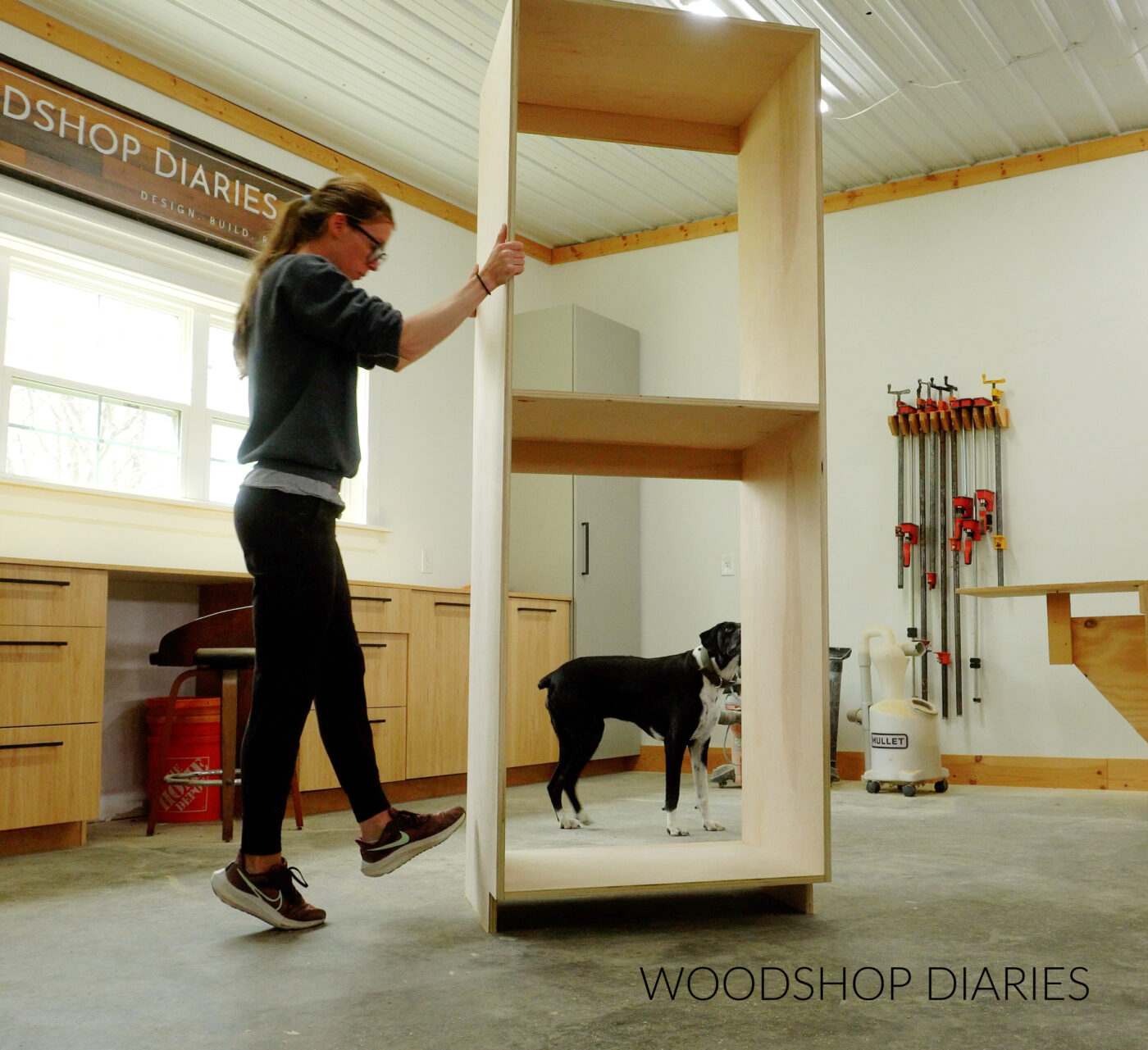
To make the most efficient use of the space inside, I wanted to add adjustable shelves into the top section, but I wanted to add pull out shelves (or basically shallow drawers) into the bottom section.
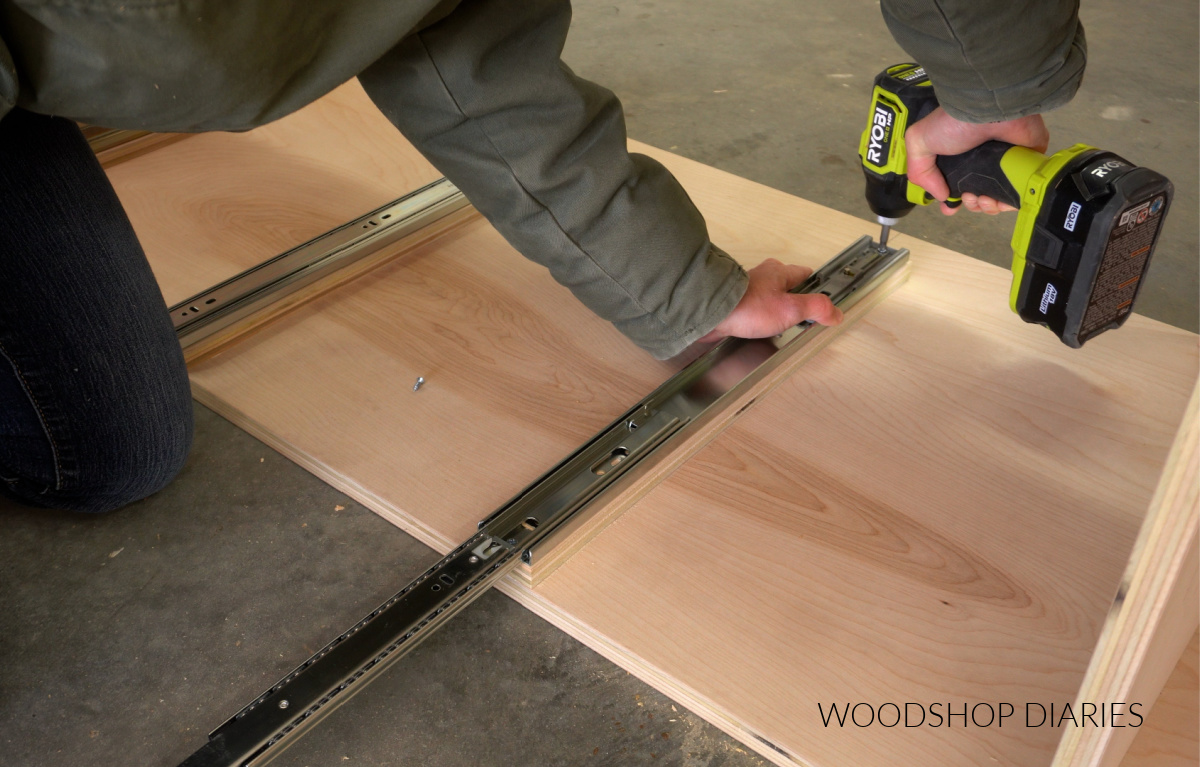
I’ll install the shelves in the next step, but first, I needed to install the drawer slides under the middle panel in each cabinet for the pull out shelves.
In order for these slides to clear the doors when they’re added later, I needed to mount them onto some scrap blocks. So before installing the slides, I glued and screwed 3 pair of ¾″ plywood strips to the inside of each cabinet.
Then, I installed 22″ drawer slides onto these scrap blocks so that I could add three pull out shelves in each tall cabinet.
RELATED: How to install side mount drawer slides
Once the slides were in, I cut and stapled a ¼″ plywood panel over the back side of each cabinet and flipped everything back upright to see how things were fitting together so far.
Prefer to print? Grab the printable garage cabinet with workbench building plans here.
Step 3: Add Shelves to Garage Cabinets
Things were starting to take shape, so next, I needed to add the shelves inside the cabinet.
For the adjustable shelves, I drilled shelf pin holes in both cabinets above the middle shelf. Learn how to install adjustable shelves in this post.
But for the bottoms, I assembled six total (three for each cabinet) shallow drawer boxes for the pull out shelves.
To make these, I ripped 2 ½″ wide strips of ¾″ plywood and screwed them together at the corners to make the sides. Then I glued and stapled ¼″ plywood over the bottom.
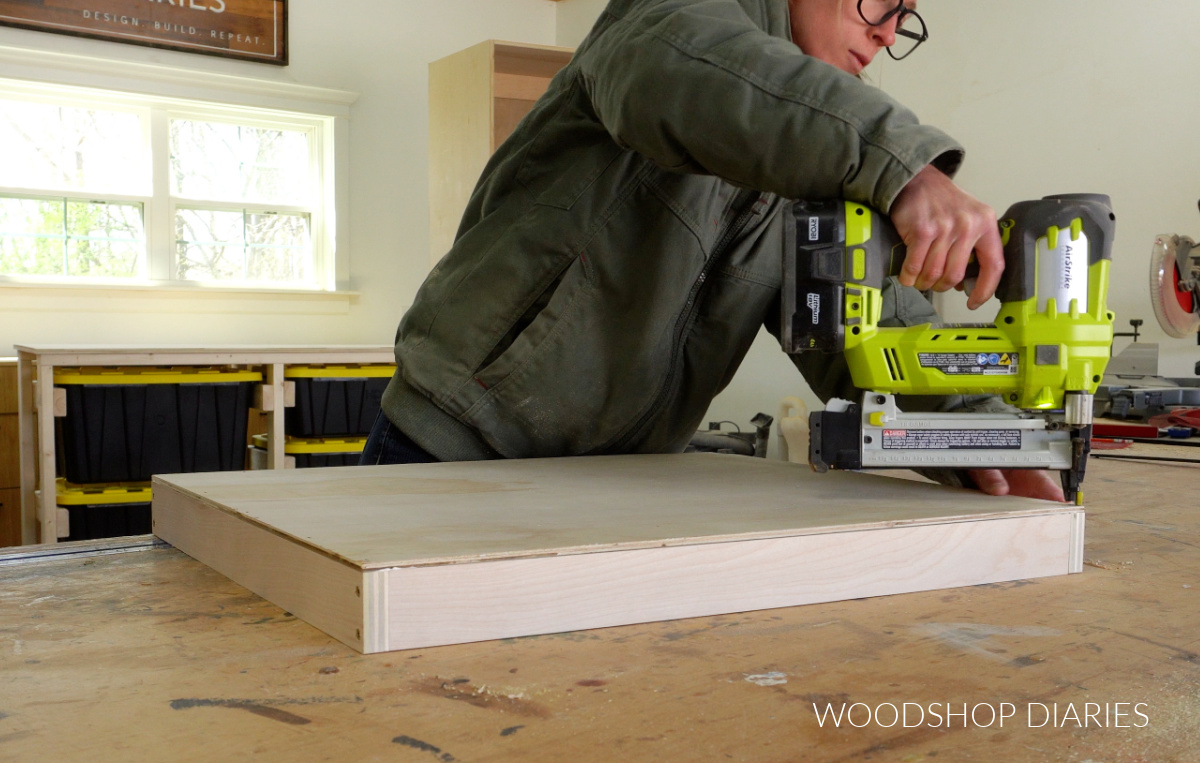
Then I installed these into my cabinets onto the slides. These are so nice for storage because you can pull them out to grab or see whatever is tucked away in the back.
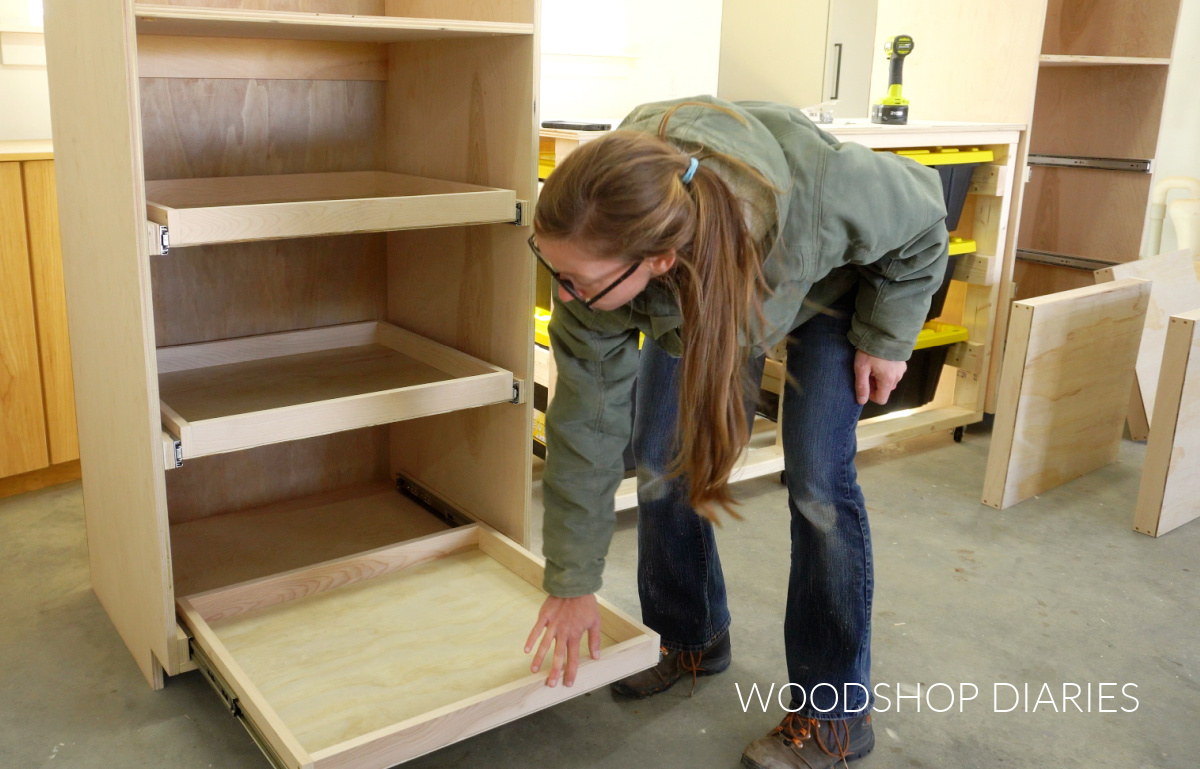
Finally, to finish up these tall cabinets, I cut two tall ¾″ plywood cabinet doors to cover the front of each cabinet.
I made sure these fit first, but waited to install them until after painting. See step 5.

Step 4: Assemble Upper Cabinets
Now that the tall cabinets were built, I just needed to build the two upper cabinets to finish things up. I built both of these upper cabinets using ¾″ plywood.
One of these upper cabinets will go above the workbench between the two tall cabinets. So it built it about ¼″ wider than the workbench top so that there would be a little wiggle room between the cabinets to roll this in between them.
Since this cabinet was so long, I assembled it with two sides, a long top and bottom, but I added a middle divider and two back supports to help prevent it from sagging.
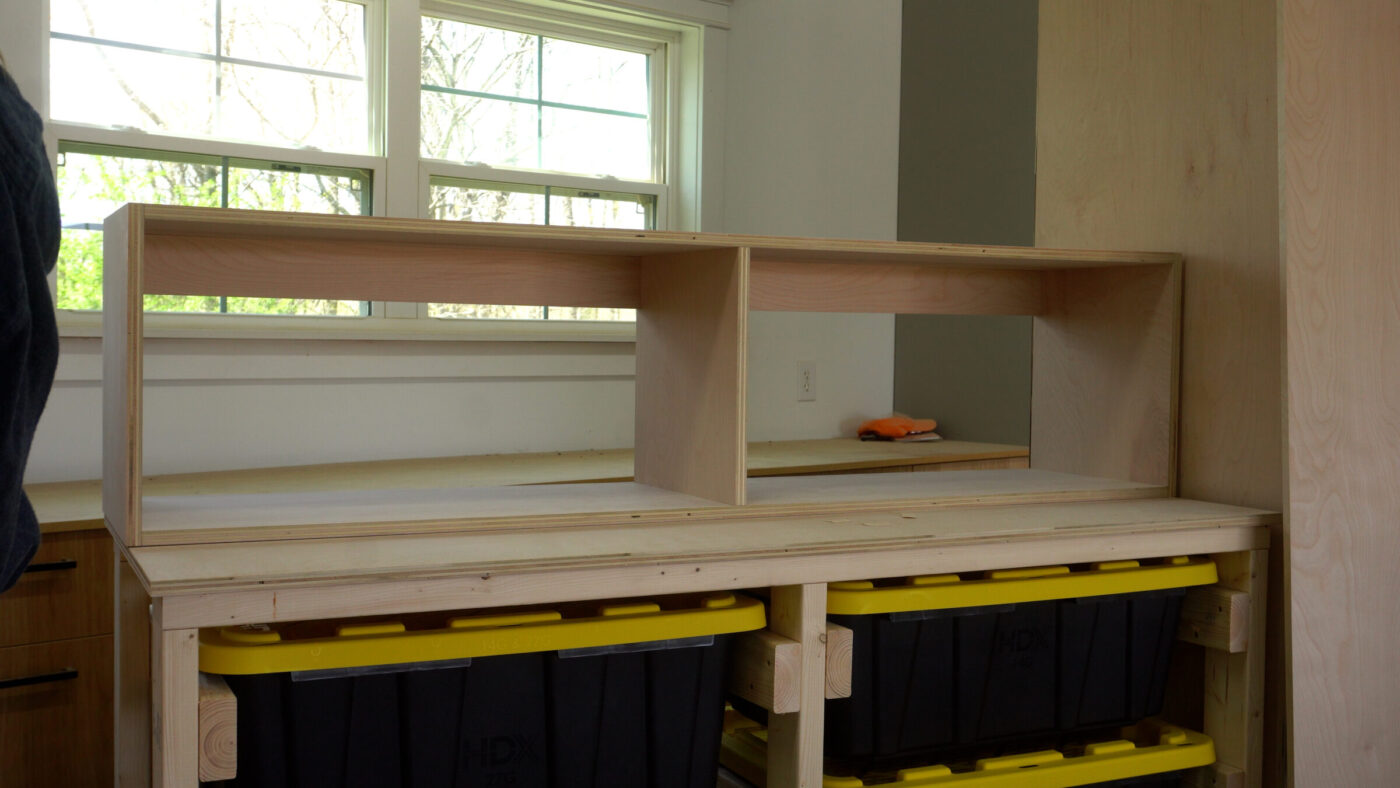
The smaller upper cabinet is completely optional. In my design, I planned to add a small shelving unit on the left side of the left tall cabinet. The shelf I had bought wasn’t very tall, so I had plenty of space above to add another cabinet.
I figured I might as well use that space, but if you don’t need or want the extra cabinet on the side, feel free to skip it.
This smaller cabinet is assembled just like the larger upper cabinet except without a middle divider. It’s just four sides and a back support.
To finish these up, I cut ¾″ plywood doors for each cabinet. I cut two doors for the smaller upper cabinet (shown below). And I cut four doors for the larger upper cabinet–two doors for the left section and two doors for the right section.
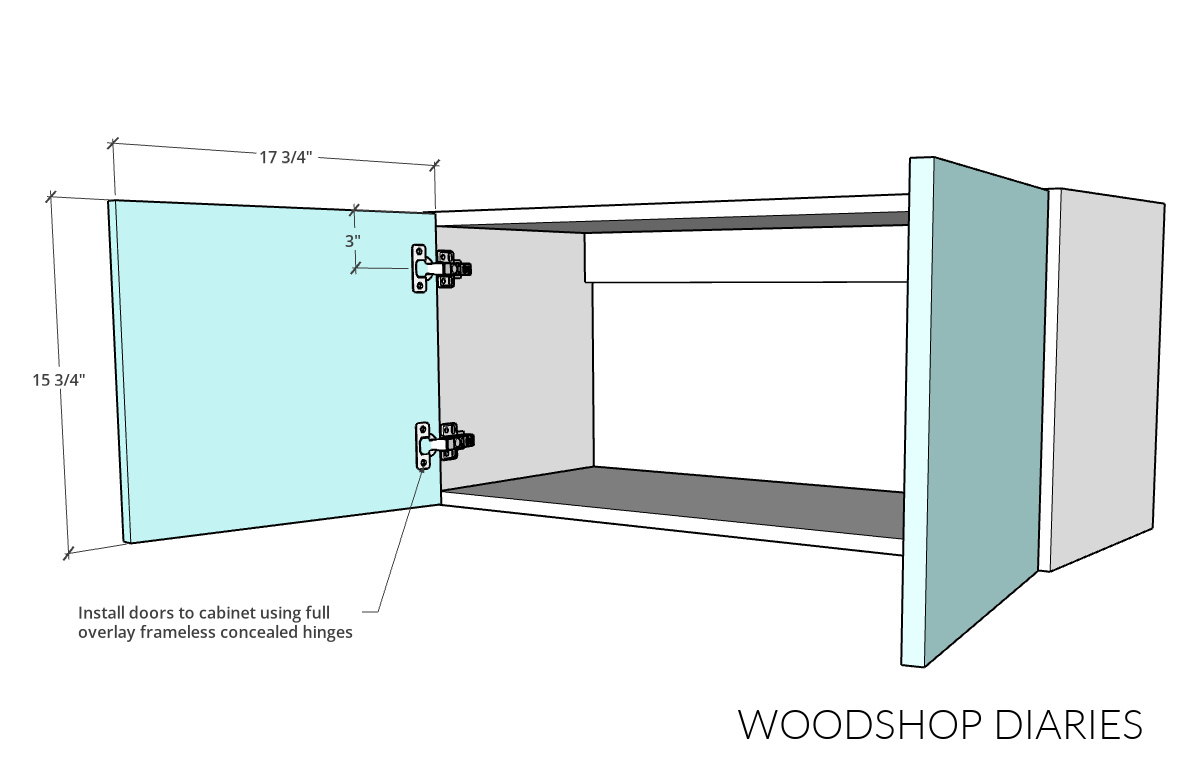
I recommend waiting to to install all the doors onto the cabinets until after they were painted.
Step 5: Finish Cabinets
Now that all the pieces were cut and assembled, I primed and painted the cabinets and the doors.
Learn how to paint DIY cabinets and furniture here.
I applied one coat of primer and two coats of paint. The color used here was Behr Power Gray.
Once the paint was dry, I installed the hinges to the door, then hung the doors onto all four of the cabinets.
RELATED: How to install concealed hinges
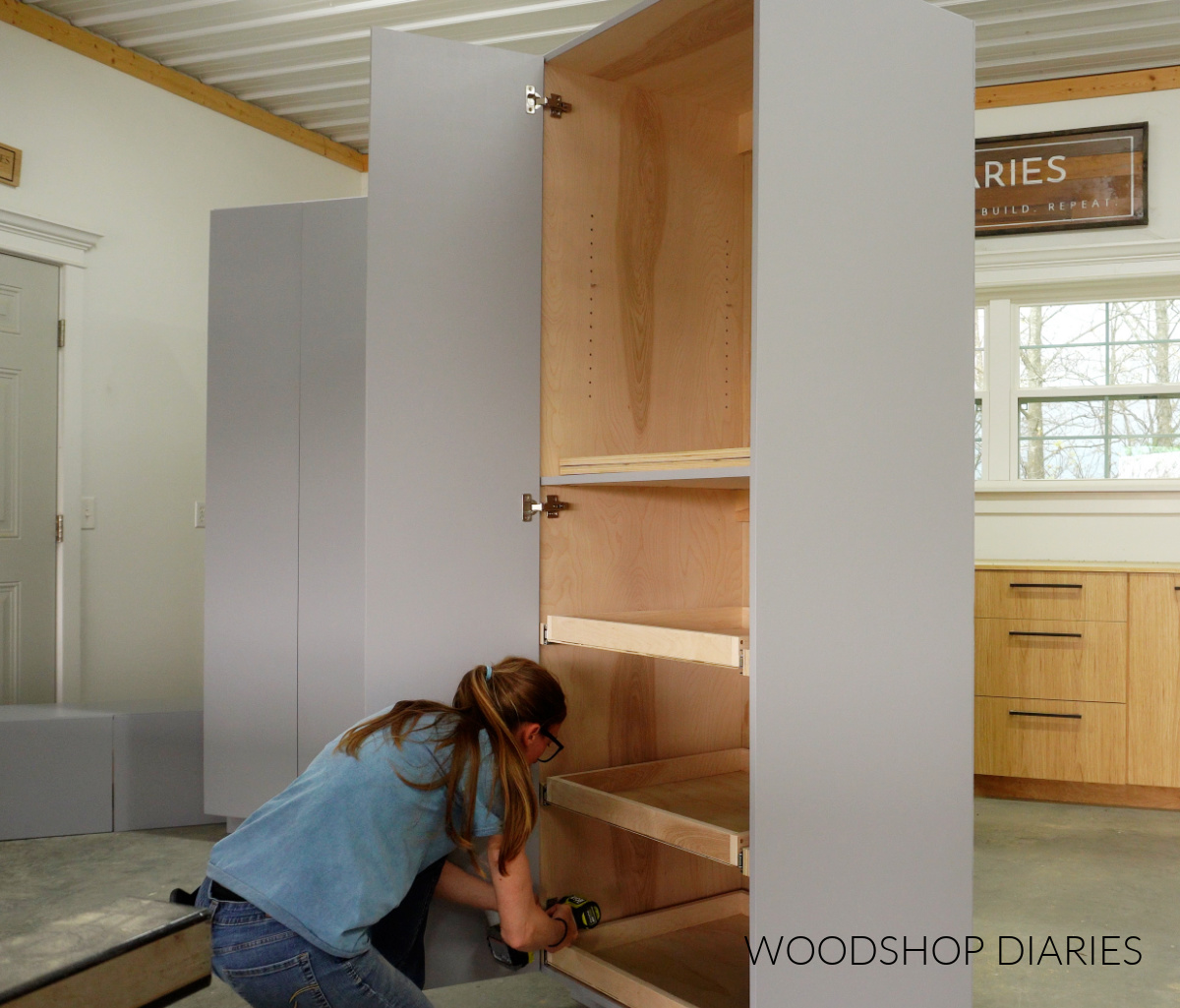
After adding some handles and knobs to the doors, I loaded them up to transport to my sisters garage to install.
Step 6: Install Garage Cabinets
I installed all of these cabinets by driving screws through the back supports into the wall studs behind the drywall.
You can install these just about any order that you want, but we started with the far right tall cabinet first. Once we positioned it where we wanted, I used a few shims to get it level (most garages will have uneven floors, so use shims to get cabinets level) before securing to the studs.
Then, I placed the large upper cabinet next to it so that they were even at the top and secured it to the wall studs through the back supports as well.
To give my brother in law somewhere to hang his tools, I hung a piece of pegboard underneath this cabinet–which is totally optional.
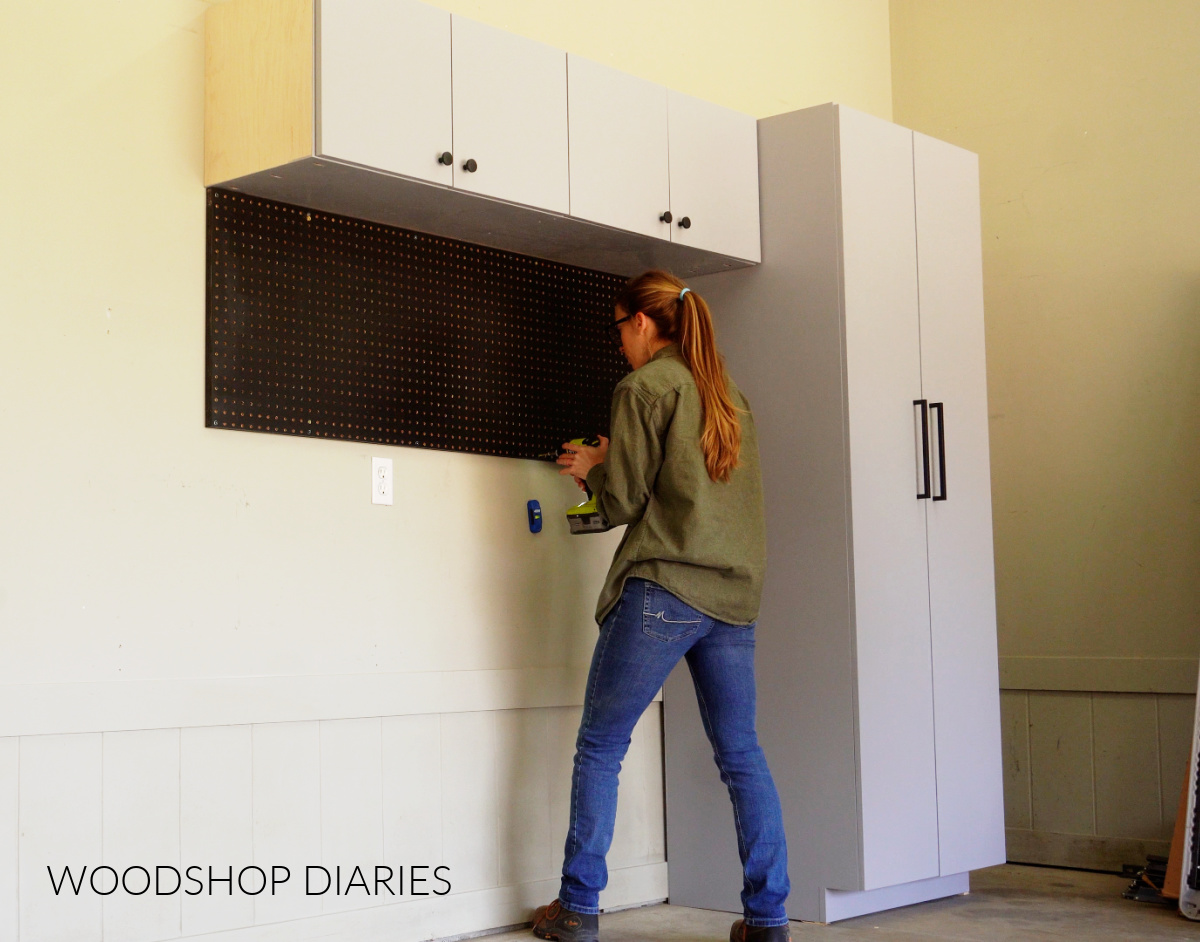
Then, we placed the other tall cabinet to the left and secured it to the wall studs just like the first one. And finally added the small upper cabinet next to that.
At that point, I could roll the mobile tote storage workbench into place and slide the totes in.
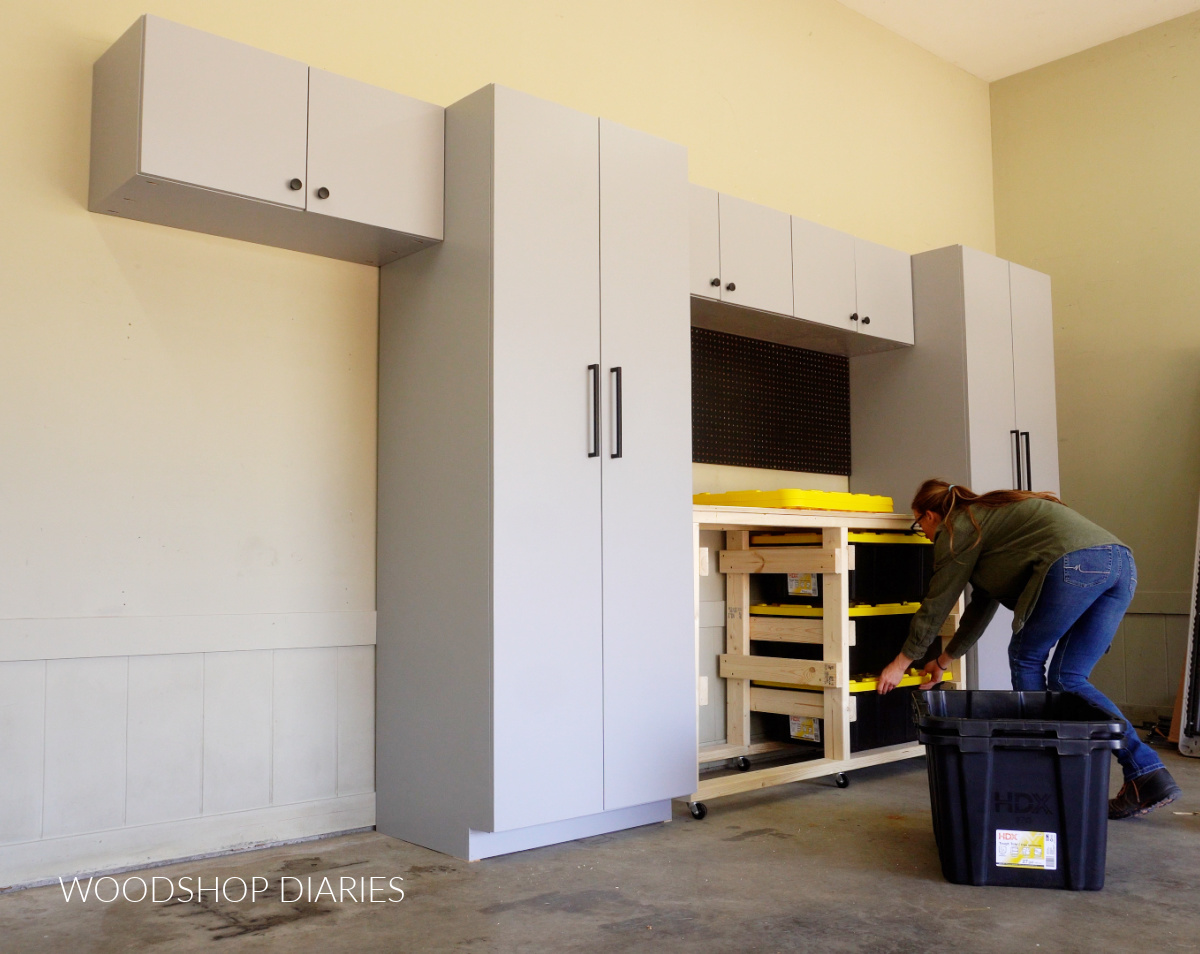
To give them somewhere to put their shoes and other “quick grab” items, I added a simple shelving unit under the smaller upper cabinet.
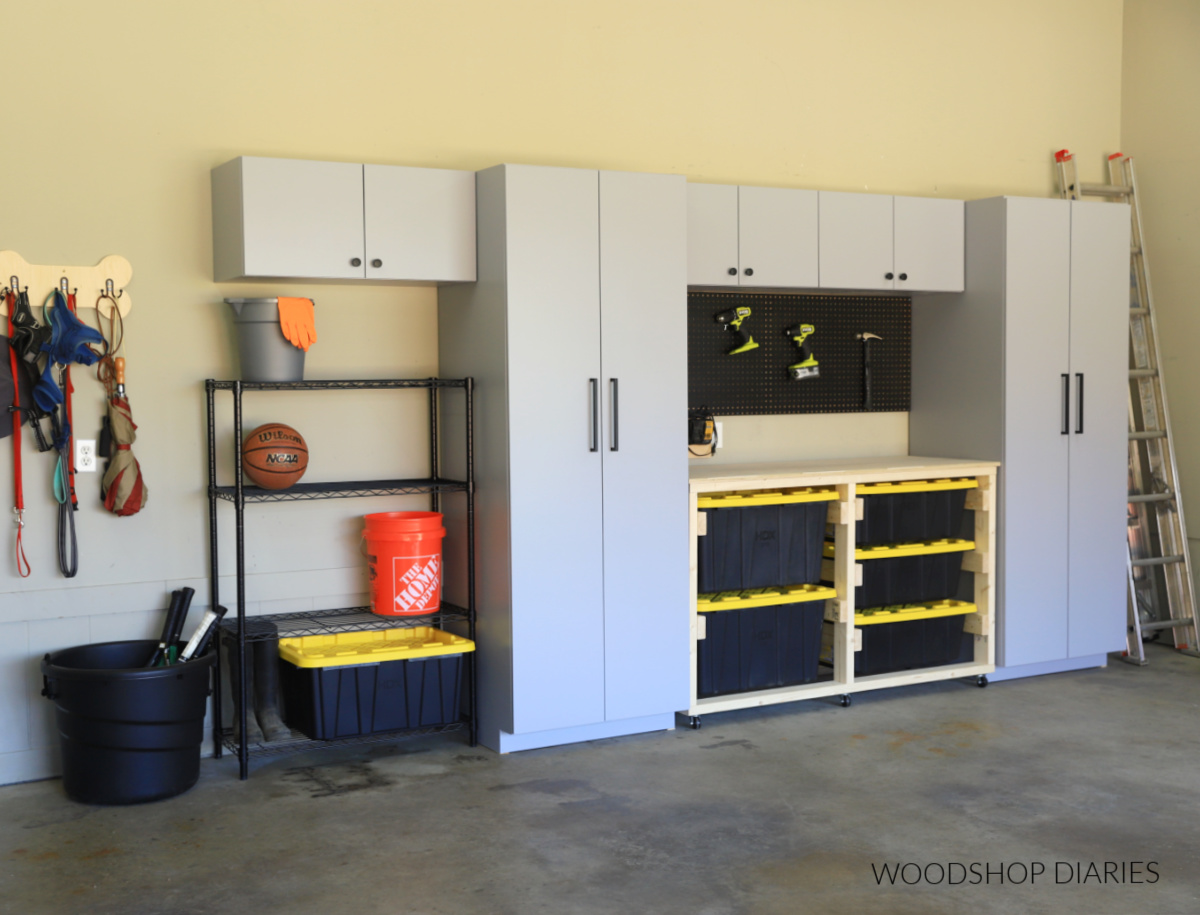
I also mounted the battery chargers to a piece of plywood to hang above the workbench. I did the same thing for my parents’ garage makeover last year.
This is a really simple way to create a consolidated battery charging station.
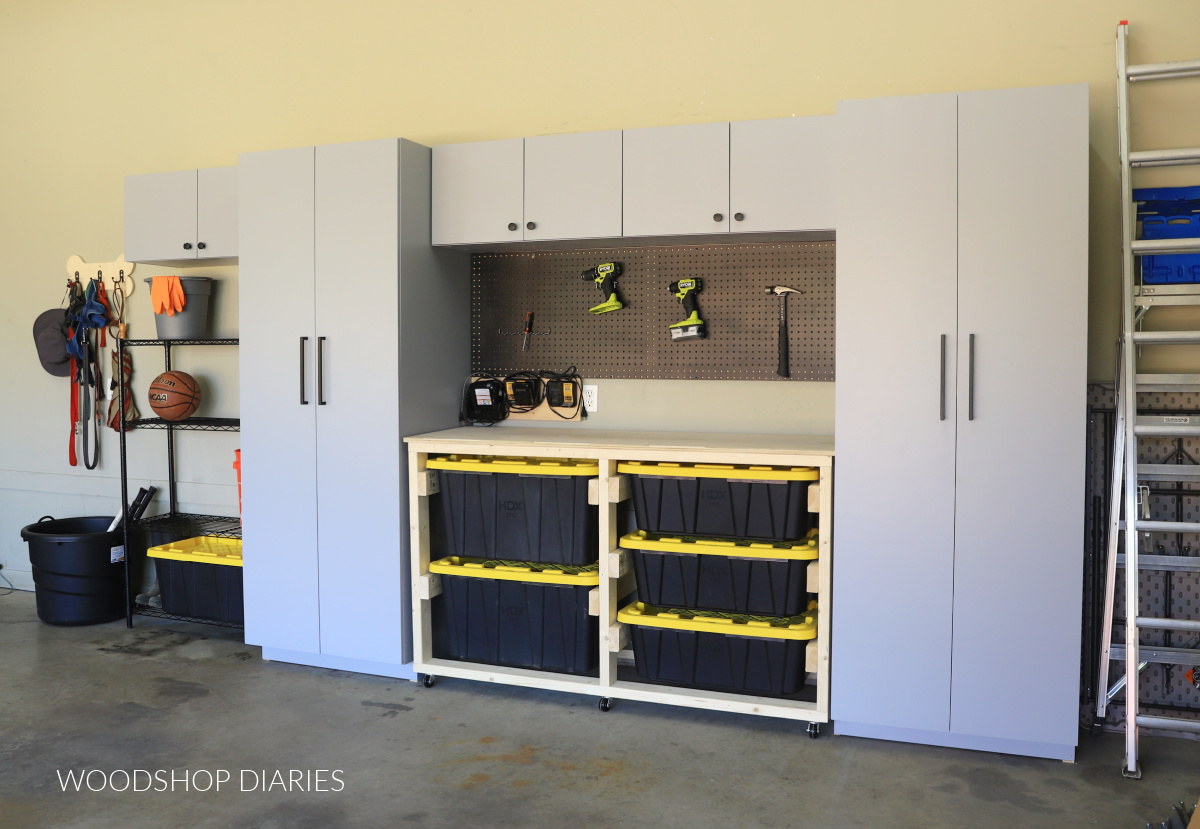
If you’re ready to build your own garage cabinets with workbench, grab the printable building plans here!
Looking for more garage storage and organization ideas?
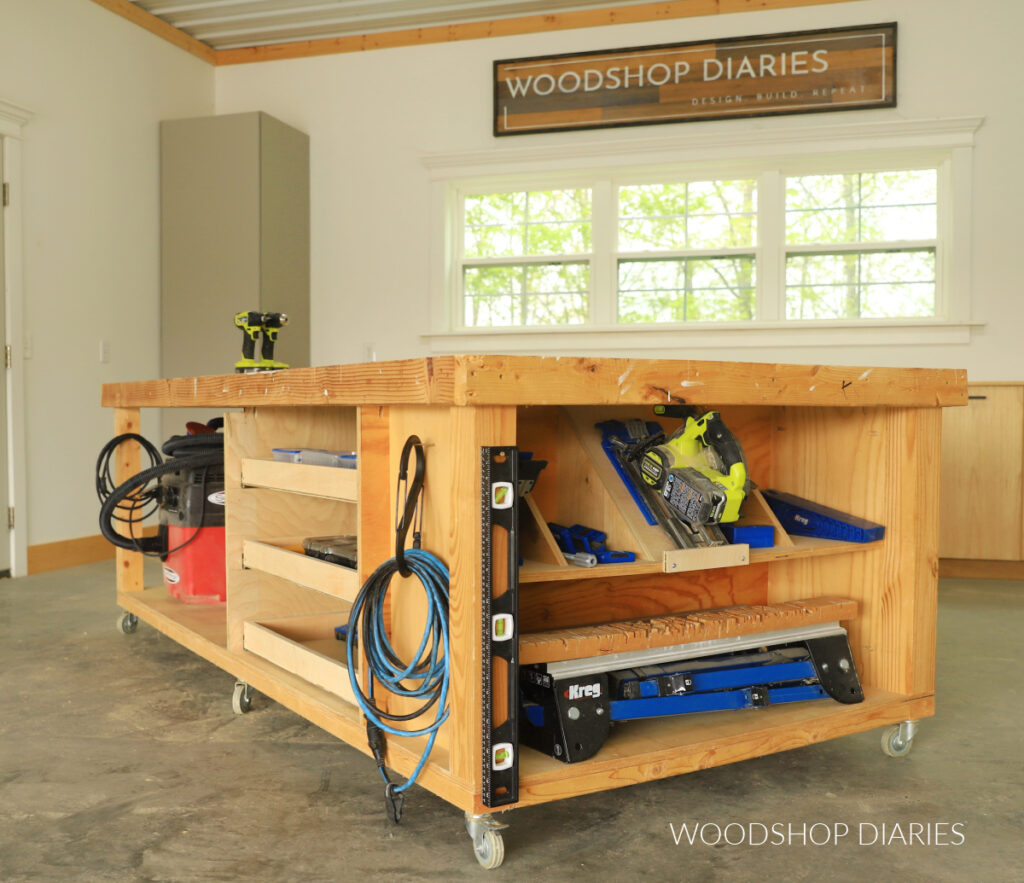
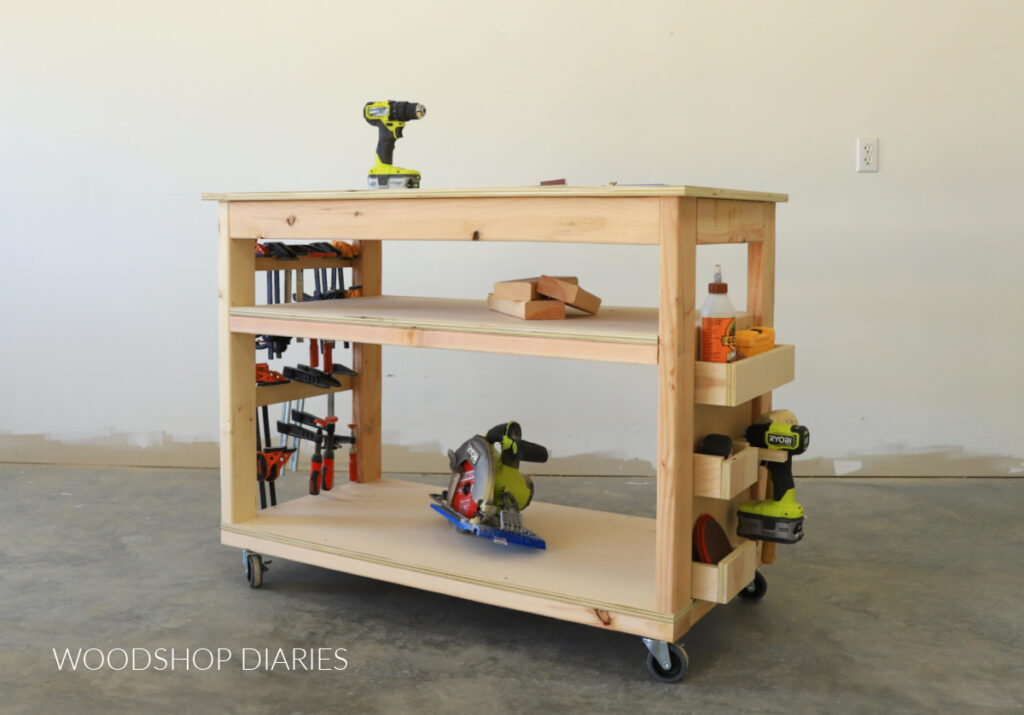
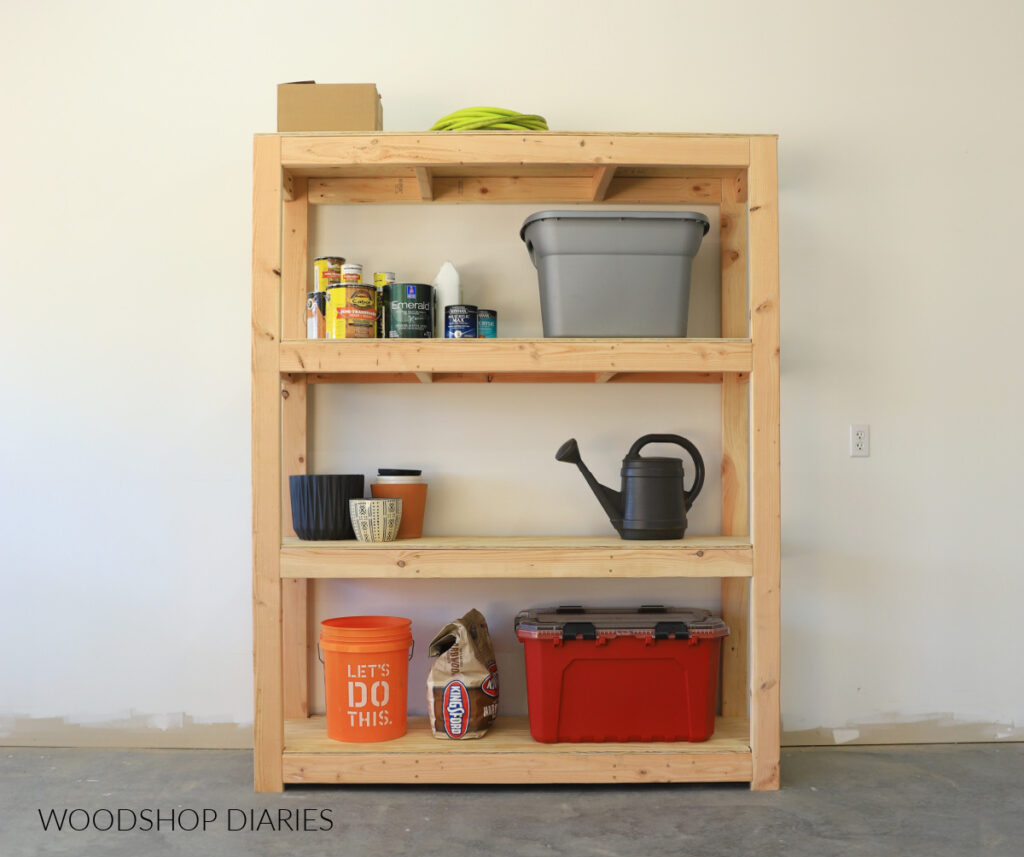
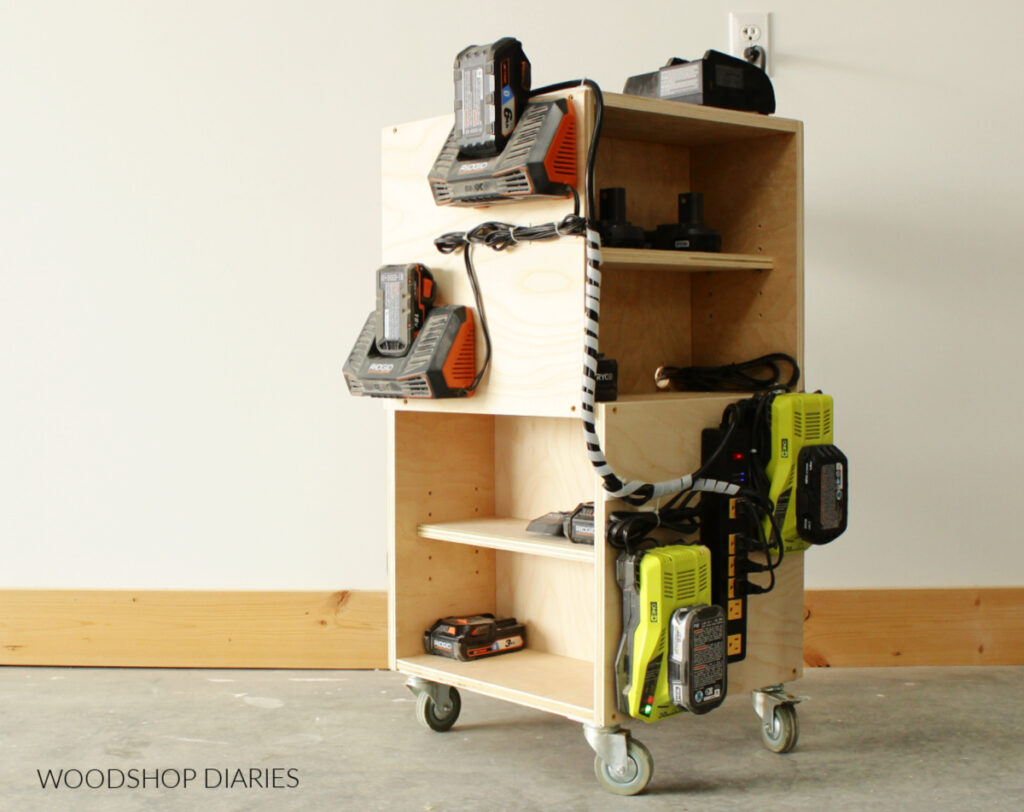
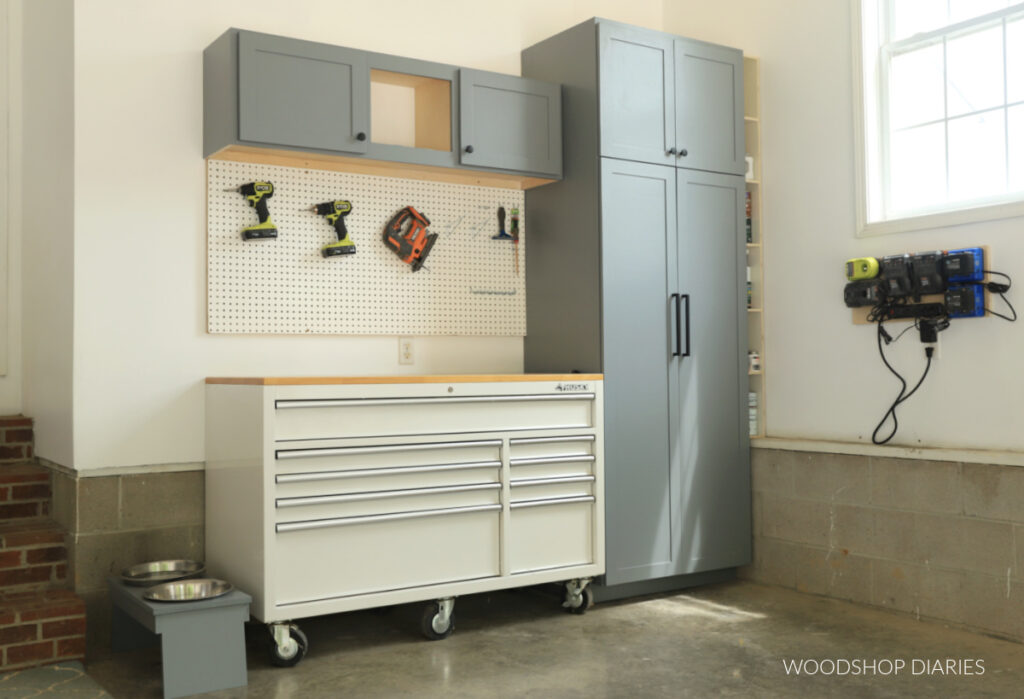
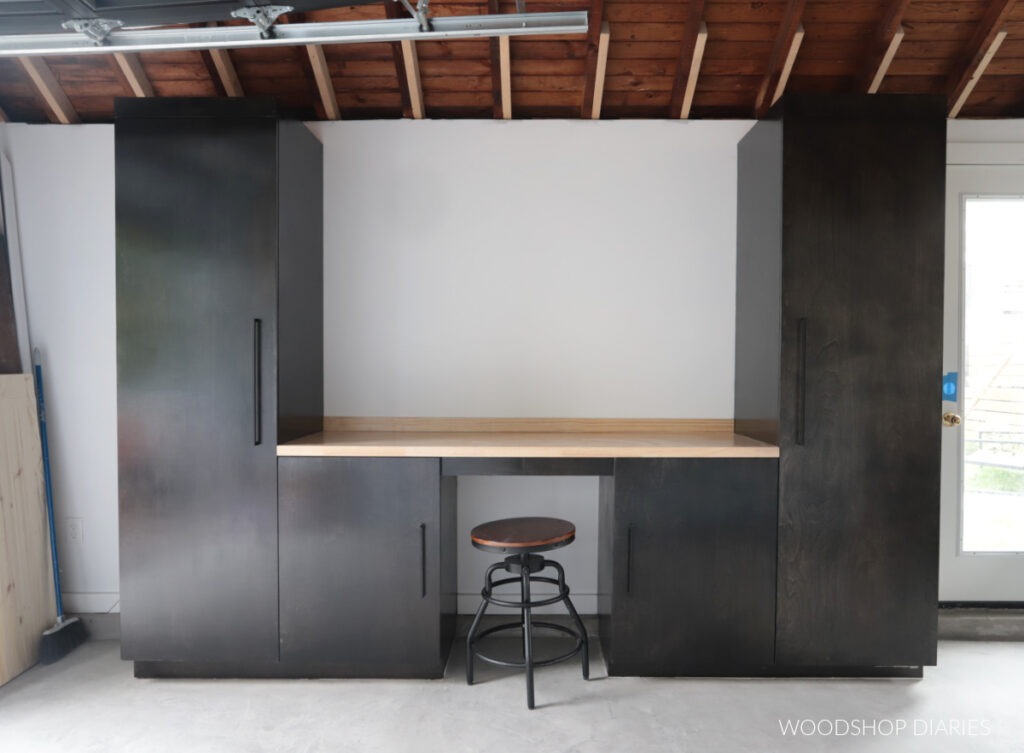
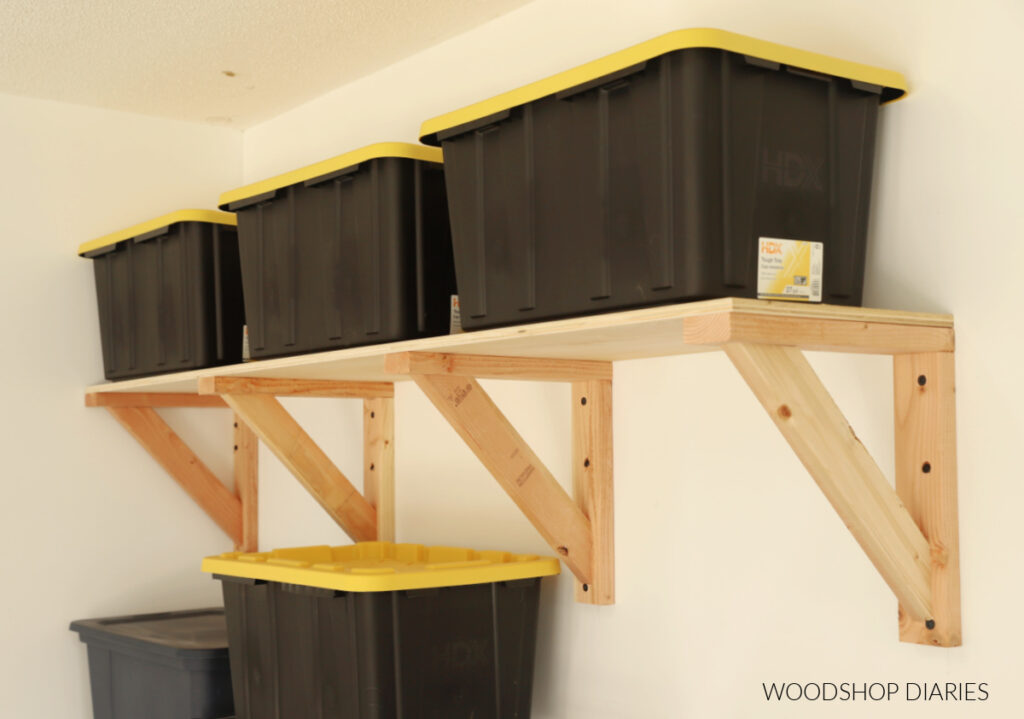
Enjoyed this project, but looking for more garage and shop storage ideas? You’ll love these, too! Click on the image(s) below to see how to make each one.
If you enjoyed this project and want to save it for later, be sure to pin it or share to your favorite social channel!
Until next time, friend, happy building!